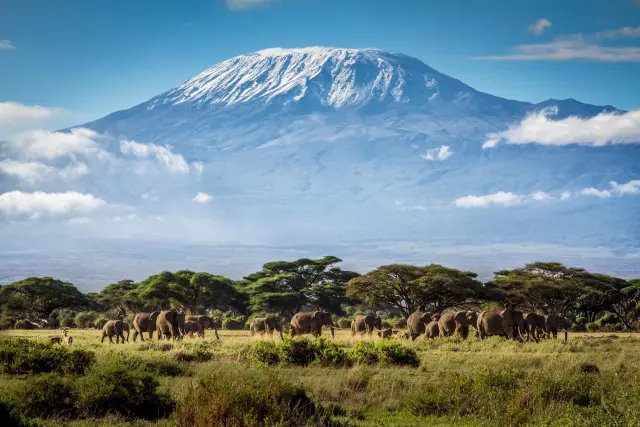
Everything you need to plan your climb to Uhuru Peak — Africa’s highest point at 5,895 m. No technical skills needed: with the right route, good preparation and experienced local guides, most fit travellers can reach the summit.
Your result is based on your Body Mass Index, stamina, age, altitude experience and the itinerary you choose. It takes less than a minute.
This calculator gives a general estimate based on published summit statistics and common risk factors. It is not medical advice. Everyone climbing to high altitude should see a doctor before booking — especially if you have a medical condition or take regular medication.
Yes. Many people who reach the summit have never trekked before. The key isn’t hiking experience but proper acclimatisation, which is best achieved on a 7–8 day route with an experienced guide.
No ropes, harnesses or mountaineering skills are needed on any of the main routes. The Barranco Wall involves some easy scrambling using your hands — most climbers find it a highlight.
A good benchmark: you can comfortably run 5 km or hike 10 km in a day, and can walk for 5–6 hours on several days in a row. Regular cardio training in the months before helps a lot.
Summit night. You set off around midnight and climb for 6–8 hours in the cold and dark to reach Uhuru Peak at sunrise. It’s tough — but the slow pace and your guides keep you going.
The national park’s minimum age is 10. There is no upper limit — healthy climbers in their 60s and 70s summit every year, usually by choosing a longer, gentler route.
With a reputable operator, a well-paced itinerary and daily health monitoring, Kilimanjaro is a safe adventure. Listening to your guides and reporting symptoms early is the most important safety rule.
Metres above sea level, camp by camp
After a scenic drive from Arusha or Moshi and registration at Londorossi Gate, the trek begins in lush montane rainforest. Watch for colobus monkeys and turacos on a gentle first walk to Mti Mkubwa (“Big Tree”) Camp.
Leave the forest for giant heather and open moorland, cross the ancient Shira caldera and enjoy your first wide views of Kibo’s glaciers. A long, rewarding day across one of the highest plateaus on earth.
The key acclimatisation day. Climb to the 4,630 m Lava Tower for lunch, then descend to Barranco Camp to sleep. Climbing high and sleeping low helps your body adapt for summit night.
Start with the famous Barranco Wall — a fun, hands-on scramble (no ropes needed) — then follow a rolling trail beneath the southern glaciers to Karanga Valley. A short day to rest and hydrate.
A steady climb over rocky ridges to Barafu, the base camp for the summit. Arrive by early afternoon, eat an early dinner and rest — your guides will brief you and check your gear for the night ahead.
Set off around midnight, climbing slowly by headlamp to Stella Point on the crater rim for sunrise, then on to Uhuru Peak — the roof of Africa. After photos, descend to Barafu for a short rest, then down to Mweka Camp (3,100 m).
A final walk down through the rainforest to Mweka Gate, where you receive your summit certificate. Celebrate with your crew, then transfer back to your hotel for a well-earned hot shower.
You can climb all year round, but the driest and most popular seasons are January to early March and June to October. The rainy months bring quieter trails, wetter conditions and fewer clear views.
A typical price range per person for a quality climb, depending on the route, number of days, group size and season. A large share of every climb goes to Kilimanjaro National Park fees (conservation, camping and rescue fees).
Be careful with very cheap offers — they often cut corners on food, equipment and fair pay for porters.
Get an exact quoteLonger climbs are both safer and more successful. What a safe climb looks like:
Start 3–6 months before your climb. Aim to comfortably run 5 km and hike 10 km in a day.
Book a check-up with your doctor and tell them you’re climbing to nearly 6,000 m.
Acute Mountain Sickness (AMS) can affect anyone, regardless of fitness. The best prevention is time: a 7+ day itinerary, walking slowly — “pole pole” — drinking 3–4 litres of water a day, and climbing high but sleeping low.
Headache, tiredness, loss of appetite, mild nausea, dizziness and poor sleep. Tell your guide — rest and water usually help.
Confusion, loss of balance or coordination, breathlessness at rest, a wet cough, or a severe headache that does not improve.
You will pass through five climate zones, from around +25 °C in the rainforest to −15 °C on summit night. Layering is everything. Porters carry your duffel (about 15 kg max); you carry a 30–35 L daypack. Tick items off as you pack — we’ll remember your progress on this device.
“The climbers who reach the summit aren’t always the fittest — they’re the ones who walk slowly, drink plenty of water and are honest with their guide about how they feel. Give the mountain enough days, and it will give you the summit.”— The Kili Hike Adventures mountain team, Arusha
Lemosho starts on the remote western side of the mountain, winding through quiet rainforest before crossing the vast Shira Plateau. Its gradual climb profile gives your body time to adapt, which is why it has one of the highest summit rates on Kilimanjaro.
Known as the “Whiskey Route”, Machame is the most popular path to Uhuru Peak. It offers superb variety — rainforest, heath, the Lava Tower and the famous Barranco Wall — and a classic climb-high, sleep-low profile.
Marangu — the “Coca-Cola Route” — is the oldest route and the only one with sleeping huts instead of tents. Its gentle, steady gradient makes it feel easier, but the short itinerary gives less time to acclimatise.
Rongai is the only route approaching from the north, near the Kenyan border. It is drier and much quieter than the southern routes, with a gentle climb and a wild, remote feel — a great choice in the rainy months.
Umbwe is the shortest, steepest and most direct way up Kilimanjaro. It climbs hard through dense forest on narrow ridges before joining the southern circuit — a challenge best suited to fit, experienced trekkers.
The Northern Circuit is the longest route on Kilimanjaro, circling the quiet northern slopes before the summit push. With the most days at altitude, it offers the best acclimatisation and the highest success rates of all.
Success rates are estimates based on commonly published figures for well-paced itineraries and are not a guarantee.
Share the journey with like-minded travellers on set departure dates.
A dedicated crew for you, your family or your friends.
Tell us your preferred dates, route and group size on WhatsApp or by email.
We recommend the right route and length for you, with a clear, all-inclusive quote.
Confirm with a deposit and share your medical, dietary and gear details with us.
We meet you at the airport, run a full briefing and gear check, and the adventure begins.
No. Kilimanjaro is a trek, not a technical climb — no ropes or mountaineering skills are needed. What matters most is good general fitness, a positive mindset and choosing an itinerary long enough to acclimatise (7 days or more).
Most climbs take 6 to 9 days on the mountain. The shortest possible itinerary is 5 days on the Marangu route, but longer climbs give your body more time to adapt to altitude and have much higher summit success rates. We recommend 7–8 days.
The driest and most popular months are January to early March and June to October. April, May and November are the rainy seasons — the trails are quieter but wetter. The northern Rongai route is a good option if you want to climb in the rainy months.
The minimum age set by Kilimanjaro National Park is 10 years old. There is no maximum age — people in their 70s and 80s have reached the summit. Older climbers should get a medical check-up and choose a longer route.
Your policy must cover high-altitude trekking up to 6,000 m, emergency evacuation (including helicopter rescue) and medical treatment. Standard travel insurance often excludes high altitude, so check the small print before you travel.
Fly into Kilimanjaro International Airport (JRO), about an hour’s drive from both Moshi and Arusha. We can collect you from the airport. Most nationalities need a visa for Tanzania, which you can apply for online before you travel.
Absolutely — it’s the perfect way to recover after the summit. Many climbers add a 2–4 day safari to Tarangire, Ngorongoro and the Serengeti, or a few days on Zanzibar’s beaches. Ask us to build a combined itinerary.
Tell your guide immediately — never hide symptoms. Guides monitor every climber’s condition daily. Mild symptoms can often be managed by resting and drinking more water, but if symptoms worsen, the safest treatment is to descend. Your safety always comes before the summit.
Rated by our travellers on SafariBookings, where every review is checked independently. Read the reviews